 Book now
 The History of the Duchess Anna Amalia Library
From an 18th-century duchess's passion to the working library of Goethe and Schiller, and its rescue after the 2004 fire — the story of Weimar's Rococo Hall.
Few libraries carry a story like this one. Shaped by a duchess, guided by Goethe, damaged by fire and painstakingly reborn, Weimar's Rococo Hall is a monument to the German literary imagination and to the people who saved it.
A duchess who built a library
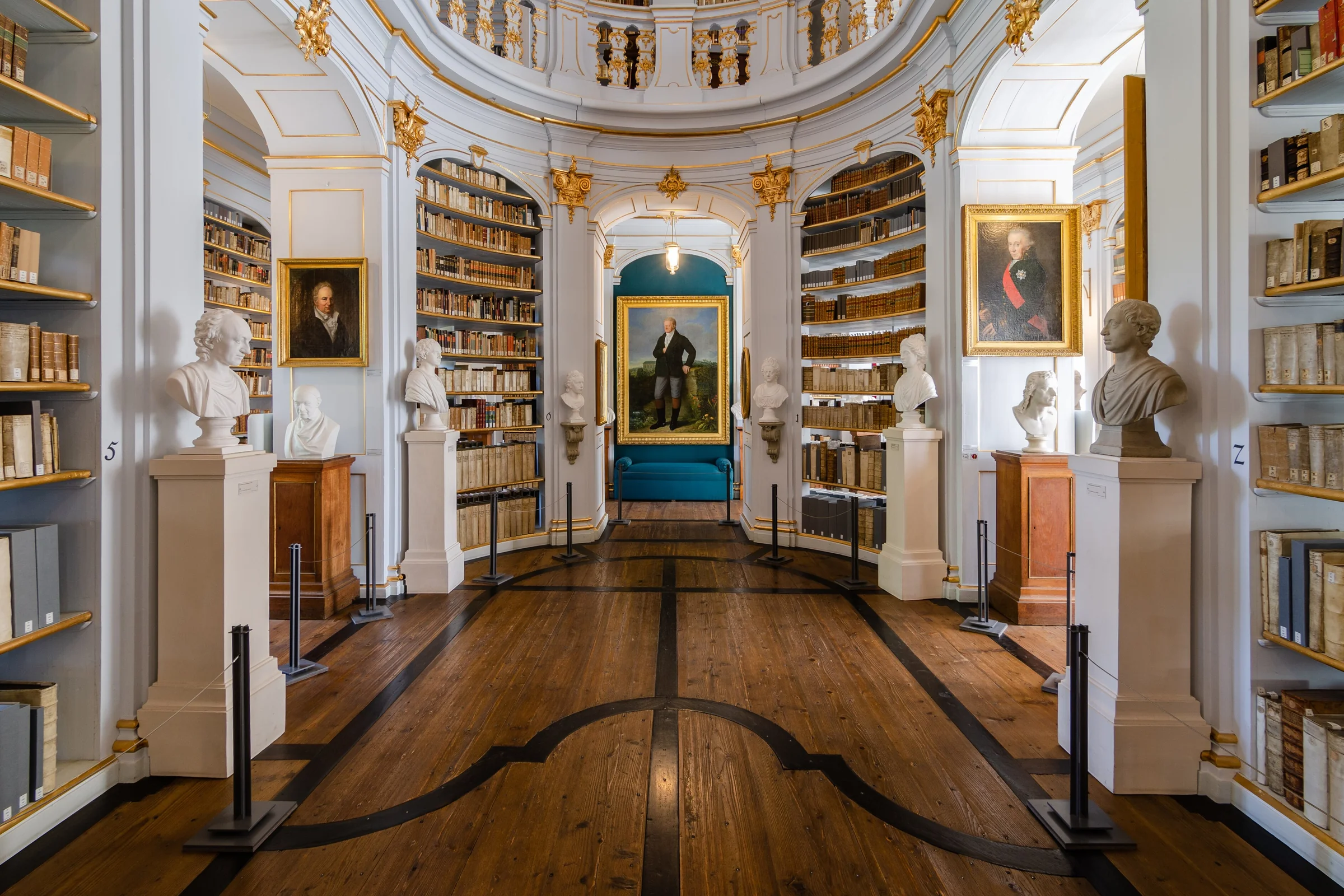
The library owes its character to Anna Amalia, Duchess of Saxe-Weimar-Eisenach, who governed the small central-German duchy as regent for her young son in the second half of the eighteenth century. Weimar was a modest court, but Anna Amalia had ambitions that outran its size. Herself a musician and composer, and a patron with a genuine appetite for books and ideas, she set out to turn a princely collection into something more like a public instrument of learning. The ducal library already existed, but it was scattered and cramped, and she wanted it housed in a manner worthy of the age of Enlightenment. In 1766 the collection was moved into the Grünes Schloss, the Green Palace, a Renaissance-era residence on what is today the Platz der Demokratie in the centre of Weimar. The building was remodelled inside to receive the books, and at its heart rose the room that has made the library famous ever since: a luminous oval hall in the Rococo taste, ringed with tiered galleries of white and gold and warm wood, lit from above by an oval skylight. Busts and portraits of poets and thinkers looked down from the balustrades onto the reading floor. It was, from the start, both a working store of knowledge and a deliberate work of art — a space that treated reading as something close to a civic and aesthetic rite. Under Anna Amalia's encouragement the collection grew steadily, and Weimar began to draw scholars, writers and musicians into her orbit. The library she shaped became the seed of the town's extraordinary cultural flowering, and long afterwards, when the institution was renamed in her honour, it was this founding impulse — a ruler who believed a great library belonged at the centre of civilised life — that the name was meant to remember.
Goethe and the working library of Weimar's golden age
By the 1770s Weimar had become an unlikely capital of German letters. Anna Amalia and, after him, her son Carl August drew to the court a constellation of writers whose names would define an entire epoch: Johann Wolfgang von Goethe, arriving in 1775; Friedrich Schiller, later his close ally; Johann Gottfried Herder, the philosopher and critic; and Christoph Martin Wieland, tutor and poet. Together they created what later generations called Weimar Classicism, and the library on the Platz der Demokratie was its practical engine. This was not a museum but a place of use. Herder preached and wrote in the town; Schiller researched his histories and dramas; the whole circle borrowed, consulted and argued over the books held here. From 1797 Goethe himself took on the supervision of the ducal library, a responsibility he kept until his death in 1832 — more than three decades of stewardship. He was no absentee patron. Goethe took the acquisition of books seriously as a matter of state and of scholarship, steering purchases, absorbing whole collections, and thinking hard about how a research library should be organised and made useful to the people who depended on it. Under his eye the holdings expanded well beyond belles-lettres into science, history and the arts, reflecting the encyclopaedic range of his own mind. To stand in the Rococo Hall today is therefore to stand in a room that the author of Faust knew intimately as an administrator as well as a reader — a space he shaped, stocked and answered for. That double identity, at once a shrine of the golden age and the ordinary daily workshop of its greatest writers, is what gives the library its particular resonance. The genius of Weimar did not happen around the library; it happened, in large part, inside it.
Building one of Germany's great literary collections
The stewardship of Goethe and his successors set the library on a course that, over two centuries, turned a court collection into one of the foremost research libraries of German literature. Today it holds on the order of a million volumes, and its strengths run deep in exactly the period Weimar itself made famous — German literature and cultural history from the middle of the eighteenth century into the nineteenth, the age of Enlightenment, Classicism and Romanticism. Among its treasures is one of the most important collections anywhere devoted to Faust: the legend of the scholar who bargains with the devil, the many literary and dramatic versions it inspired across the centuries, and above all Goethe's own monumental handling of the theme. Around that core the library has gathered manuscripts, rare early printings, historic bindings and the working papers that let scholars trace how ideas travelled and how texts changed. The building has always been more than a single famous room. Behind and around the Rococo Hall lies a full research institution, with reading rooms, exhibition space and, in modern times, a study centre and underground stores built to serve readers and protect fragile material. The library's remit is genuinely scholarly: it exists to be used by researchers as well as admired by visitors, and its collections continue to grow through purchase and donation. What a curious eighteenth-century duchess began as an act of enlightened patronage has become an indispensable archive of the German literary imagination — a place where the raw material of a national culture is kept, catalogued and made available. The beauty of the hall, in the end, is only the most visible sign of a much larger seriousness of purpose that has accumulated, book by book, over more than two hundred and fifty years.
A jewel of the Classical Weimar World Heritage Site
The library does not stand alone. It is one of the buildings inscribed by UNESCO as part of the World Heritage Site known as Classical Weimar, a designation that recognises the town as one of the great crucibles of European culture. Weimar's importance is out of all proportion to its size. It is the city of Goethe and Schiller, whose houses stand within a short walk of the library; it is the town where Herder preached and where Wieland worked; and in the twentieth century it became the birthplace of the Bauhaus, the design movement that reshaped modern architecture and everyday objects across the world. Few towns of comparable scale have left so long a mark on how people write, build and think. The Anna Amalia Library sits at the heart of this ensemble, on the Platz der Demokratie in the historic centre. Around it cluster the other sites that make Weimar a place of literary pilgrimage: Goethe's house and the Goethe National Museum, Schiller's house, the Weimar City Palace, and the Park an der Ilm with Goethe's Garden House, all within an easy stroll. To visit the Rococo Hall is therefore not to see an isolated curiosity but to enter one room of a much larger monument — a whole town preserved as a record of the German Enlightenment and Classical age. The World Heritage listing also carries an obligation: these are places held in trust, and the conservation rules that govern how the library can be visited flow directly from that responsibility. When you plan a trip around the hall, you are really planning a trip into Classical Weimar as a whole, and the library rewards being seen as the keystone of that story rather than a stop ticked off in isolation.
The catastrophe of 2004
On the evening of the second of September 2004, fire broke out in the historic library building. It took hold in the roof and upper reaches of the Rococo Hall, the most vulnerable place imaginable — a timber-galleried room packed with paper and centuries of dry wood. The blaze became one of the most serious cultural disasters in postwar Germany. Tens of thousands of books were destroyed outright, and tens of thousands more were damaged by fire, heat, smoke and the water used to fight the flames; many of the losses were irreplaceable. As the fire spread, townspeople, staff and volunteers formed human chains to carry endangered volumes out of the building by hand, rescuing treasures from the path of the flames even as the hall burned above them. Among the works saved were pieces of the greatest rarity and value, pulled to safety in an improvised effort that became, in its own right, part of the library's story. The images of the gutted hall — the galleries charred, the skylight open to the night — travelled around the world, and the loss was felt far beyond Weimar. For an institution whose identity was bound up so completely with a single, irreplaceable room, the fire was not merely damage to a building but a wound to a shared cultural memory. It also exposed, painfully, how much of a fragile inheritance had been concentrated in one place. The disaster prompted an outpouring of solidarity: donations, offers of expertise and public attention flowed in from across Germany and abroad. But the immediate reality was stark. The hall that Anna Amalia had built and Goethe had tended lay ruined, its future uncertain, and the task of deciding whether and how it could be brought back began almost before the embers had cooled.
Restoration and the reopening of 2007
What followed was one of the most closely watched restoration projects of its generation. The decision was taken not to abandon the hall but to bring it back — to repair the structure, restore the galleries and painstakingly conserve what could be conserved. Fire-damaged and water-soaked books were treated by specialists; charred fragments were sorted, dried, cleaned and, where possible, pieced back together in a conservation effort that would continue for years. The building itself was stabilised and the Rococo interior rebuilt to recover the room's original luminous character of white, gold and warm wood. Craftspeople, conservators and scholars worked side by side, and the project drew financial and moral support from far beyond Weimar, a mark of how much the hall meant to people who had never set foot in it. A little over three years after the fire, in October 2007, the restored Rococo Hall reopened to the public. The reopening was widely reported as a quiet triumph: proof that even a catastrophic loss to cultural heritage could be answered with patience, skill and resolve. Visitors returning to the hall found the room recognisably itself again, its galleries and skylight restored, its collections back on the shelves. But the fire changed the library permanently in one crucial respect. To protect the recovered hall and the fragile books it holds, the institution now limits how it can be visited: entry to the Rococo Hall is controlled, with a strict daily cap on the number of people admitted and short, timed viewings rather than open browsing. Those rules are not bureaucratic fussiness; they are the direct legacy of 2004, the price of keeping the hall alive. The restoration did more than repair a room. It renewed a promise to hand this place on intact to the readers of the future.
Why readers still make the pilgrimage
More than two and a half centuries after Anna Amalia moved her books into the Green Palace, the Rococo Hall remains a place people cross Europe to see. Part of the draw is simple beauty: it is regularly named among the most beautiful libraries in the world, and photographs rarely prepare visitors for the effect of standing inside the oval, ringed by tiers of galleries and looking up through the skylight. But the deeper pull is what the room represents. This is the working library of Goethe and Schiller, a place where a whole literary age did its reading; it is a treasure house of German letters; and it is a survivor, a room that came back from the fire. For lovers of books and of libraries, few destinations are so laden with meaning. Seeing it, though, takes a little planning, and that planning is itself a consequence of the history above. Because the hall is capped and protected, admission works by timed slot, with only a limited number of tickets released for each opening day, and a viewing that lasts roughly half an hour. Those slots genuinely sell out well in advance, especially at weekends and in the peak season, and demand comfortably outstrips the small daily allocation. This is where a concierge service earns its keep: we arrange your timed ticket for a date and slot that is genuinely available, confirm the slot when we secure it, and if your preferred day is already full we help you find a workable alternative rather than leave you guessing. The hall rewards the effort. To visit is to close the circle of this story — to stand in the room a duchess built, a poet tended, and a community saved.
Frequently asked
Who was Anna Amalia and why is the library named after her?
Anna Amalia was Duchess of Saxe-Weimar-Eisenach and regent of the duchy in the later eighteenth century. A musician and patron, she had the ducal collection moved into the Green Palace in 1766 and shaped it into a true library, including its famous Rococo Hall. The institution later took her name in tribute.
What is Goethe's connection to the library?
Goethe lived and worked in Weimar and used the library throughout his life. From 1797 until his death in 1832 he also supervised it, steering its acquisitions and organisation for more than three decades. The Rococo Hall is a room he knew intimately as both a reader and its administrator.
What happened in the 2004 fire?
On 2 September 2004 a fire severely damaged the Rococo Hall, destroying tens of thousands of books and damaging many thousands more. Townspeople and staff formed human chains to rescue endangered volumes. After a closely watched restoration, the hall reopened in October 2007, though visits are now strictly limited.
Why are visits limited to a timed slot?
To protect the restored hall and its fragile collections, entry is capped at a set number of people per day and organised as short, timed viewings of about thirty minutes rather than open browsing. These conservation rules are a direct legacy of the 2004 fire and the effort to preserve the room.
Do I need to book in advance?
Yes. Because the daily allocation of timed tickets is small and demand is high, slots sell out well ahead, especially on weekends and in peak season. We book only dates and slots that are genuinely available and confirm your slot when we arrange it, helping you find an alternative if your first choice is full.