 Book now
 Inside the Rococo Hall: Art, Light and Books
A close look at the oval hall of white, gold and warm wood in Weimar — its galleries of books, its watchful busts, and the light that fills it.
The Rococo Hall is the reason people travel to the Anna Amalia Library. This is a close look at the oval room itself — its light, its galleries of books, its watchful busts, and the fire it survived.
An oval room built of light and gold
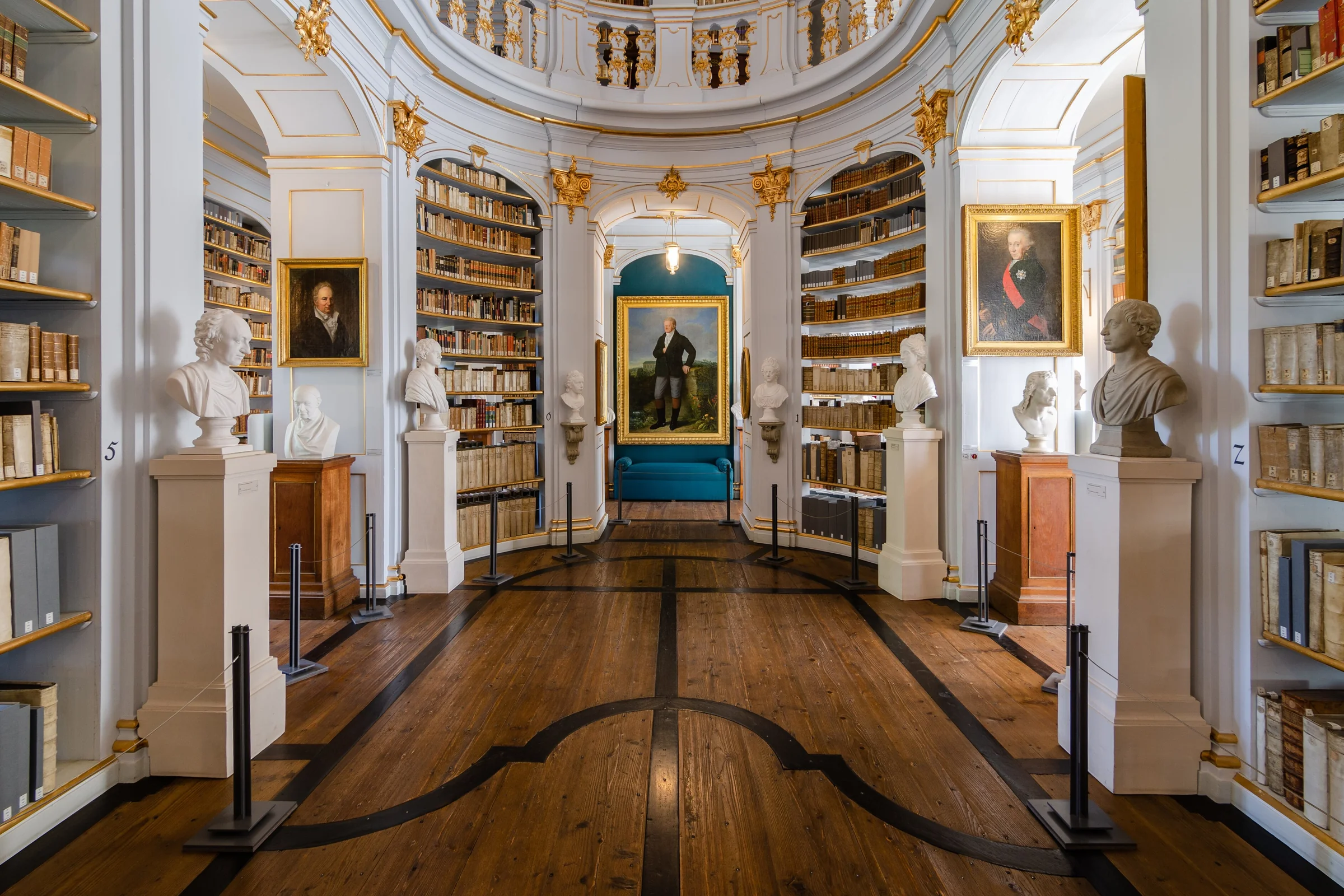
Nothing quite prepares you for the first moment inside the Rococo Hall. The room is oval, and that shape does the quiet work of pulling your eye around and upward rather than letting it settle on a single wall. The palette is disciplined and warm: white plasterwork, soft gilding that catches the daylight, and the honeyed brown of old wood and older bindings. The effect is not gaudy, as "gold" might suggest, but luminous — a room that seems lit from within even on a grey Thuringian afternoon. Tiers of galleries rise around the central floor, each one a slender balcony faced with a low balustrade, and behind the balustrades stand the books: rank upon rank of spines climbing toward the ceiling. Columns and pilasters break the curve into rhythmic bays, so the wall of volumes reads as a colonnade rather than a warehouse. Look up and the room resolves into its crowning feature, an oval opening at the centre of the ceiling that lets natural light pour down onto the floor below. The proportions are eighteenth-century and human-scaled; this was designed as a working library for a small court, not a monument to intimidate. That is part of why the hall feels intimate despite holding so much. You are standing inside a single, unified idea of what a library should be — a place where architecture, decoration and the physical mass of books are all in service of the same warm, legible whole. Give yourself a moment simply to stand at the centre and turn slowly. Almost everyone does.
The busts and portraits that watch the room
Look along the galleries and between the bays and you will meet the room's other inhabitants: busts and portraits of the writers and thinkers who made Weimar a capital of the mind. They are placed deliberately, at eye level and above, so that the hall feels less like a store of paper and more like a company of minds gathered in one place. This was the working library of Weimar's golden age, the period when the small ducal town drew poets, philosophers and scholars into an extraordinary concentration of talent, and the sculptures and paintings are the room's way of keeping that company present. Goethe, who served for years as the library's supervisor, is among the faces you will recognise; so are other figures of the Weimar Classical age whose names anchor German literature and thought. The portraits are not incidental decoration bolted on after the fact. They are integral to the atmosphere, turning a beautiful room into a kind of secular pantheon where the books and the people who wrote, read and argued over them share the same space. Part of the pleasure of a visit is the slow game of recognition — matching a marble profile to a name you half-remember from school, or simply registering how many of them there are. The effect is quietly moving. You sense that this was never a passive archive but a place of active intellectual life, and that the men and women commemorated here treated these shelves as tools of their trade. Standing among them, you understand why Weimar calls itself the city of Goethe and Schiller, and why this particular room became the symbol of that inheritance.
A million volumes and the treasures within
The books you see lining the galleries are the visible face of a much larger holding. Across the library as a whole there are somewhere in the order of a million volumes, of which the Rococo Hall displays only a fraction — the historic, decorative and most emblematic part of the collection. What the hall shows you is not a random shelf but a curated wall of the library's memory, spines and bindings chosen and arranged so that the room reads as a single composition. Among the deeper treasures is an important collection gathered around Faust: the legend, its literary afterlives, and the towering version that Goethe wrote here in Weimar. For a room so bound up with Goethe's own working life, that concentration of Faust material feels less like a curiosity and more like the collection turning to face its own history. You will not leaf through these volumes yourself — this is a conservation-first environment, and the books are protected accordingly — but knowing what surrounds you changes how the hall feels. The shelves stop being scenery and become a real, consulted, catalogued library that happens to be breathtaking to stand in. It is worth remembering the scale of what is here: centuries of print, manuscripts and rare editions, assembled and shaped from the eighteenth century onward under the duchess whose name the library now carries, and expanded ever since. The hall is the jewel, but it sits within a genuine research institution. That combination — a room of real working depth that also happens to be one of the most photographed interiors in Germany — is exactly what makes a visit feel weightier than a simple sightseeing stop.
Why it is called one of the world's most beautiful libraries
The claim gets attached to a handful of rooms around the world, and the Rococo Hall earns its place on every such list. What sets it apart is coherence. Many grand libraries overwhelm through sheer size or through a single spectacular ceiling; this one persuades through the perfect agreement of its parts. The oval plan, the warm restraint of the white-and-gold decoration, the galleries stacked with books, the busts keeping watch, the skylight overhead — none of these elements competes with the others. They compose. Stand at the centre and there is no single "best" view, because the room is designed to be beautiful from every angle as you turn. There is also the matter of light. Because daylight enters from above rather than only through side windows, the hall changes character through the day and the seasons, brightening and softening in a way that no fixed lighting scheme could imitate. A morning visit in clear weather feels different from an overcast afternoon, and regulars will tell you the room is never quite the same twice. Beauty here is not only visual, either. The hall carries the charge of what it has held and who has used it, the sense that this loveliness was built to serve serious work rather than to be admired for its own sake. That honesty — decoration in the service of function — is very much the spirit of the age that made it. Add the human scale, the quiet, and the knowledge that only a small number of people share the room with you at any one time, and you have the rare thing: a famous sight that lives up to its reputation the moment you walk in. Few interiors reward the trip so completely.
The fire of 2004 and what was lost
The hall you visit today carries a difficult recent history, and it is worth knowing before you go. In 2004 a catastrophic fire broke out in the library and severely damaged the Rococo Hall. Tens of thousands of books were destroyed, and many more were damaged by flame, heat, smoke and the water used to fight the blaze. For a collection assembled and refined over more than two centuries, the loss was irreplaceable in the literal sense: individual volumes, some of them rare or unique, that no reprint or facsimile can restore. The event was felt far beyond Weimar, because a library like this belongs in a real sense to the wider culture, and its damage registered as a loss of shared heritage rather than merely of property. It is a sobering thing to hold in mind as you stand in the restored room. The serenity of the hall today was hard-won and is not to be taken for granted. Rather than diminish a visit, that knowledge tends to deepen it: you are looking at a room that came very close to being lost altogether, and at shelves that were painstakingly reassembled around the gap the fire left. The library has been open about this history rather than hiding it, and part of the quiet dignity of the place comes from that honesty. When you look up at the galleries and the books they hold, you are seeing both what survived and what was rebuilt — a room that stands as much for recovery as for the golden age it was built to serve. It is a reminder, too, of why the conservation rules around your visit are as strict as they are.
A painstaking restoration, reopened in 2007
The response to the fire was one of the most careful restoration efforts of its kind. Over roughly three years, specialists worked to repair the fabric of the hall and to conserve the enormous number of books that had been damaged but not destroyed — a slow, meticulous business of drying, cleaning, stabilising and rebinding, carried out volume by volume. The room itself was rebuilt to return the oval hall to the appearance and atmosphere it had before the fire, so that what you see today reads as continuous with its own long history rather than as a modern replacement. The Rococo Hall reopened in 2007, and it did so as a room consciously changed by what it had survived: restored to its beauty, but now protected far more strictly than before. That protection is the reason your visit takes the form it does. Because conservation now comes first, the hall admits only a limited number of people at a time and only for a short viewing, and access is managed through timed slots with a firm daily cap. It is not a room you can simply wander into on impulse; the limits exist precisely so that the restored hall and its books are not put at risk again. Understanding that background makes the constraints feel less like an inconvenience and more like part of the experience — you are being admitted, briefly and carefully, into a room that the people who look after it are determined not to lose twice. When you plan your visit, treat those limits as the price of the room's survival. Booking ahead for a genuinely available slot is simply how a place this fragile, and this loved, is now shared.
The hall at the heart of Classical Weimar
The Rococo Hall does not stand alone, and part of its atmosphere comes from where it sits. The library occupies a historic building on the Platz der Demokratie in the centre of Weimar, a short walk from the market square and from the houses of Goethe and Schiller — the writers whose busts you meet inside the room. Step out of the hall and you are in the middle of a small town that punches far above its weight in the story of European culture: the city of Goethe and Schiller, later the birthplace of the Bauhaus, and a place whose historic core is recognised as the UNESCO World Heritage Site "Classical Weimar." The hall is one of the crown jewels of that ensemble, and seeing it in context deepens the visit. The room was not a folly or a showpiece built in isolation; it was the working library of a court and a circle of minds whose homes, gardens and studies you can still walk to within minutes. That physical closeness collapses the distance between the marble profiles on the galleries and the real streets outside, where those same figures lived and wrote. It also makes the Rococo Hall an ideal centrepiece for a wider day in Weimar rather than a standalone stop. Because your viewing is short and timed by design, many visitors build the rest of the day around it — the Goethe and Schiller houses, the city palace, the Park an der Ilm with Goethe's garden house, the Bauhaus collections. Seen that way, the hall is not just a beautiful room to tick off but the luminous heart of a town that has spent two centuries thinking about what beauty and learning are for.
Frequently asked
How long do visitors get inside the Rococo Hall?
A visit to the Rococo Hall is a short, timed viewing of roughly 30 minutes. Because the room is protected for conservation, only a limited number of people are admitted at once, so plan to arrive on time for your slot and make the most of the window you have inside.
What happened to the Rococo Hall in 2004?
A catastrophic fire in 2004 severely damaged the hall and destroyed tens of thousands of books. After a painstaking restoration of both the room and its surviving volumes, the Rococo Hall reopened in 2007 — and is now protected by strict visitor limits so it is never put at similar risk again.
Why are tickets so limited and hard to get?
Since the 2007 reopening, conservation comes first: the hall admits only a small number of visitors per timed slot, with a firm daily cap. That means tickets are genuinely limited and sell out well in advance, especially on weekends and in peak season, so it is wise to book as early as you can.
Can I take photographs inside the hall?
Many visitors want to photograph the famous oval galleries, but photography rules are set for conservation and can change, so confirm what is permitted when you arrive. Whatever the policy on the day, give yourself time to simply look — the room rewards a few unhurried minutes far more than a rushed camera roll.
Is the Rococo Hall suitable for children?
Children are welcome, and young people under 16 enter free, though a quiet timed viewing of a fragile historic room suits calm, curious visitors best. The short 30-minute format actually works well for families, since it holds attention without asking children to stay still for long.