 Book now
 Classical Weimar: Building a Day Around the Library
A small Thuringian city holds Goethe, Schiller, the Bauhaus and one of the world's loveliest libraries — here is how to see it in a day.
Weimar is a small city with an outsized place in German culture. The Rococo Hall is its scarcest treasure, so build the day around your timed slot and let the rest of the city fall into place.
A Small City That Shaped a Culture
Few places pack as much cultural weight into as few streets as Weimar. This is the city of Goethe and Schiller, the town where a duchy's court became, for a few remarkable decades around 1800, the intellectual capital of the German-speaking world. It is also the city of the Bauhaus, founded here in 1919, and later a name bound up with the darker chapters of the twentieth century. You can walk the core in an afternoon, yet each square and townhouse opens onto another layer of history.
Much of that legacy is formally recognised. The UNESCO World Heritage Site known as "Classical Weimar" gathers together the houses, gardens, palaces and the library that belonged to the golden age of Weimar Classicism — the period when writers, philosophers and a cultivated court turned a modest residence town into a laboratory of European letters. The Duchess Anna Amalia Library sits at the heart of that ensemble, both geographically and in spirit: it was the working library of that age, and Goethe himself served as its supervisor.
For a visitor, Weimar's scale is the gift. Distances are short, the pavements are calm, and you are rarely more than ten minutes' walk from the next thing worth seeing. That compactness is exactly why the city rewards a plan. The Rococo Hall is the one element you cannot simply wander into on a whim — it runs on strict, capped, timed entry — so it becomes the fixed pin on the map. Everything else, from the poets' houses to the park along the river, can be arranged loosely around it. Think of Weimar as a single, coherent open-air museum with one appointment at its centre, and the day almost designs itself.
The Rococo Hall: The Fixed Point of Your Day
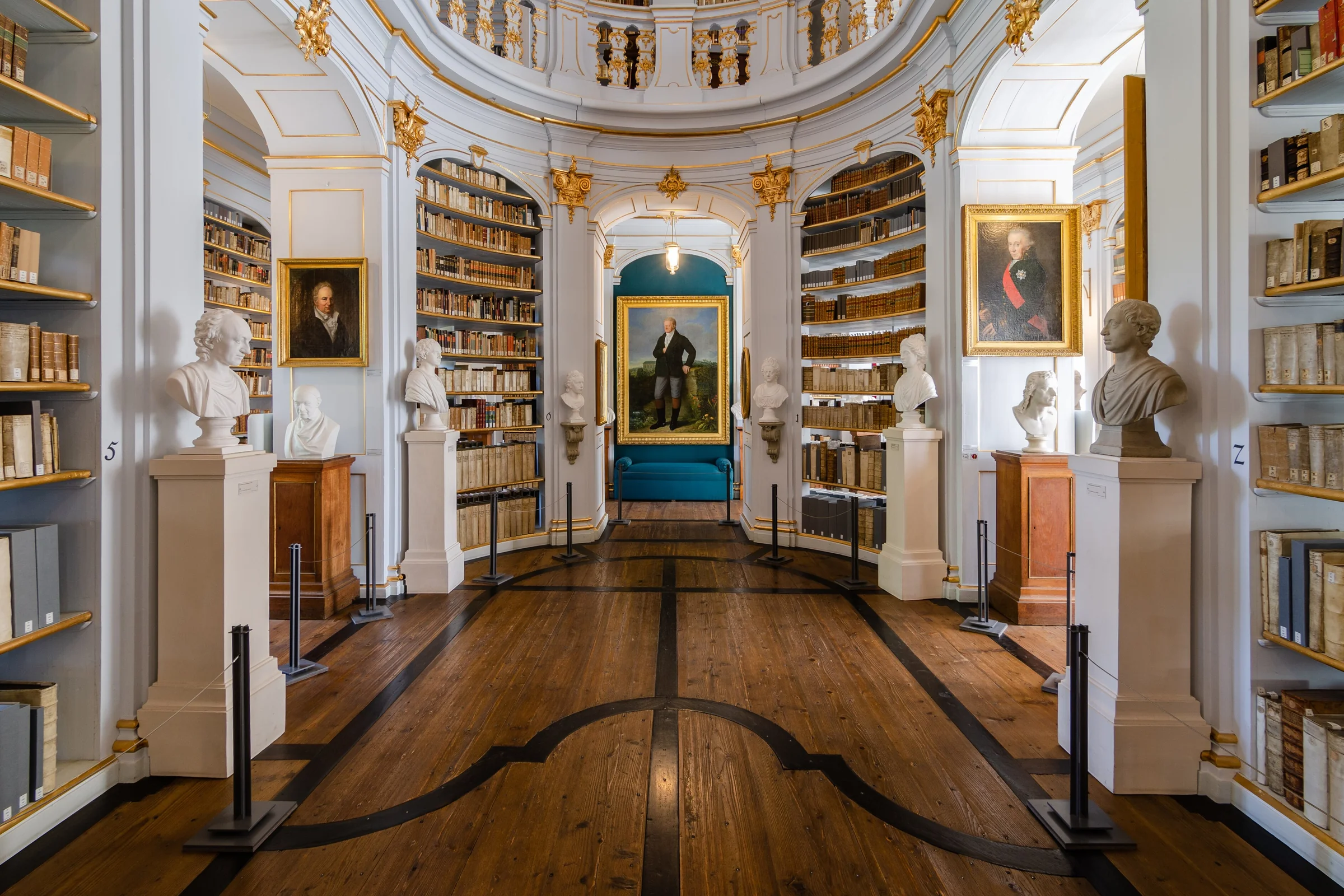
Start your planning with the one thing that is genuinely scarce. The Rococo Hall — the oval, light-filled heart of the Duchess Anna Amalia Library — is a timed-slot experience with a strict daily visitor cap, in place to protect a space that holds some of the library's roughly one million volumes across tiered galleries of white, gold and warm wood. The viewing itself is short, around thirty minutes, and only a limited number of timed tickets are released for each opening day. Because of that cap, slots sell out well in advance, particularly on weekends and through the peak season.
The hall you step into today is a careful reconstruction. In 2004 a catastrophic fire tore through the space, destroying tens of thousands of books and severely damaging the interior; the painstaking restoration reopened the hall in 2007, and the limits on visitor numbers are part of how it is now looked after. Standing beneath the oval skylight, ringed by busts and portraits of the thinkers of the Weimar Classical age, you are looking at something that was very nearly lost.
The practical consequence for your itinerary is simple: choose your library slot first, then hang the rest of the day off it. The hall is generally open Tuesday to Sunday, roughly from mid-morning into the early afternoon, and closed on Mondays, with only a handful of entry times each day and hours that shift with the season — so confirm the exact time when you book. Tickets are sold in advance, often a few months ahead, and delivered as a print-at-home or mobile PDF. We book only for dates and slots that are genuinely available and confirm your time when we arrange it; if your first choice is full, we help you find a workable alternative rather than leave you guessing. Because the visit is brief, it slots neatly into either a morning or an early-afternoon anchor.
The Poets' Houses: Goethe and Schiller
The library was the mind of Weimar Classicism; the poets' houses are its living rooms. A short walk from the library building brings you to the two addresses most travellers come for, and together they make the literary core of any Weimar day.
Goethe's House on the Frauenplan is where Johann Wolfgang von Goethe lived for much of his long life in the city, and it remains startlingly personal. The rooms are arranged much as a cultivated man of his era kept them, from the formal reception spaces to the modest study and the bed where he died, and the adjoining Goethe National Museum sets his work and world in fuller context. This is not a reconstruction viewed from behind glass so much as a house you move through, and it repays a slower pace than you might expect.
A few minutes away stands Schiller's House, the home Friedrich Schiller bought near the end of his life and where he wrote some of his best-known plays. It is a plainer, more intimate building than Goethe's, and the contrast between the two men — the settled sage and the restless dramatist who died young — comes through clearly when you see their homes on the same day.
Both houses reward advance thought about timing, and both sit within easy walking distance of the library, which is what makes the pairing so natural. A common and comfortable rhythm is to give the morning to one or both houses and hold your library slot for around midday, or to reverse it. We can't quote opening times or admission for these sights here — they are run separately and worth checking directly before you go — but geographically they could hardly be more convenient. Reading Goethe or Schiller before you travel, even a little, turns these rooms from handsome interiors into something closer to a visit.
The Palace, the Market Square and the Park an der Ilm
Between the headline sights, Weimar's everyday fabric is a pleasure in its own right, and much of it costs nothing but time. The library stands on the Platz der Demokratie, and immediately beside it rises the Weimar City Palace, the former residence of the dukes whose patronage made the classical age possible. Its long façade and courtyard anchor this corner of the old town, and even a slow circuit of the exterior helps you read how court, library and city fitted together.
From there it is a short stroll to the market square, the historic centre of Weimar, framed by gabled townhouses and the town hall. It is the natural place to pause for coffee or lunch between timed commitments, and its cafés and terraces make an easy regrouping point when you are threading several visits into one day.
The city's great green lung lies just below, along the river: the Park an der Ilm, a landscaped park in the informal English manner that Goethe himself helped shape. Paths wind past meadows, mature trees and quiet views back toward the town, and within the park sits Goethe's Garden House, the modest cottage the poet was given early in his Weimar years and returned to throughout his life as a retreat from court duties. Walking here is the best possible antidote to a museum-heavy schedule; it is also where the phrase "Classical Weimar" stops being an abstraction and becomes a landscape you can feel. If your library slot falls in the early afternoon, the park makes an ideal way to fill the morning gently; if it falls in the morning, an hour here afterward lets the day exhale before you move on.
Weimar's Other Great Layer: The Bauhaus
It is tempting to treat Weimar purely as a classical city, all poets and periwigs, but that misses half the story. In 1919 the Bauhaus — the school that would reshape twentieth-century design, architecture and art across the world — was founded right here, before it moved on to Dessau and then Berlin. The tension between Weimar's two great moments, the Goethe era and the modernist one, is a large part of what makes the city so rewarding.
The Bauhaus Museum gathers the story of that founding period and the movement's origins, from furniture and objects to the ideas that drove them. After a morning steeped in Rococo gilding and eighteenth-century letters, stepping into the clean lines and radical simplicity of the Bauhaus is a genuine jolt — and a productive one. It reframes everything you have just seen, showing how the same small city could incubate both a golden age of classical culture and a revolution against ornament little more than a century later.
For itinerary purposes, the Bauhaus Museum is the obvious anchor for the second half of a full day, once the library and the poets' houses are behind you. It gives the afternoon a different texture and a change of century, which keeps a day of sightseeing from blurring into one long procession of grand interiors. We are not able to list its opening hours or admission here, as it operates independently, so confirm those directly when you plan. But as an idea for how to spend your Weimar hours, pairing the Rococo Hall with the Bauhaus in a single day is one of the most satisfying contrasts the city offers: two visions of beauty, two centuries apart, a fifteen-minute walk from one another.
Half-Day and Full-Day Plans Around Your Slot
Because the library slot is the one fixed, scarce point, both of these plans are built outward from it. Treat the times as a framework and adjust to the exact slot you hold.
Half-day plan (library in the late morning): Arrive in the old town and start gently on the market square with a coffee, then walk to Goethe's House on the Frauenplan and give it an unhurried hour or so. Aim to reach the library on the Platz der Demokratie a few minutes before your timed entry — arriving early matters, because capped slots do not wait. After your roughly thirty-minute visit to the Rococo Hall, loop past the Weimar City Palace next door and finish with lunch back on the square. That is a satisfying morning-into-early-afternoon that captures the essential Weimar without rushing.
Full-day plan (library around midday): Open with Goethe's House and the Goethe National Museum, then walk over to Schiller's House to see the two poets in one stretch. Take your library slot near midday and let the Rococo Hall be the pivot of the day. Break for lunch on the market square, then cross the afternoon into a different century at the Bauhaus Museum. If energy and daylight allow, close with a slow walk through the Park an der Ilm down to Goethe's Garden House — an unhurried, mostly outdoor coda after a museum-rich day.
A few practical notes hold for either plan. Weimar's compactness means walking between sights is quick, so you can afford to be generous with each stop. Keep your library confirmation and PDF to hand, and give yourself a comfortable buffer before the slot rather than cutting it fine. And since the other attractions set their own hours and closing days, sketch the loose order first, then confirm each sight's timings so nothing you have counted on is shut when you arrive.
Getting to Weimar by Train
One of Weimar's quiet advantages is how easy it is to reach, which makes it a realistic day trip as well as a place to linger. The city sits on the railway in the German state of Thuringia, and the historic core — including the library on the Platz der Demokratie — is a short, walkable distance from the station and the market square, so you rarely need onward transport once you arrive.
Erfurt, the Thuringian capital and a major rail hub, is only about fifteen minutes away by train, which makes the two cities easy to combine or to use as bases for one another. Leipzig and Frankfurt are each roughly two hours out, putting Weimar comfortably within reach of larger cities and their airports for a full day's visit. Because the connections are frequent and the walk from the station into the old town is straightforward, many travellers arrive without a car at all.
That ease of access has a direct bearing on how you plan the library. The reliable rail links make it perfectly feasible to build a day around a timed Rococo Hall slot even if you are staying elsewhere in the region — but the slot itself is still the constraint, not the train. Aim to arrive in Weimar with time in hand before your entry, allowing for the short walk from the station and any coffee stop on the way. If you are coming from further afield, check train times in advance and choose a library slot that gives you a sensible margin on arrival. Once you are in town, everything in this guide is within an easy stroll, and the day unfolds on foot from there.
Frequently asked
How should I plan my Weimar day around the library ticket?
Book the Rococo Hall slot first — it is timed, capped and sells out, so it is the fixed point. Arrange the poets' houses, the palace, the park and the Bauhaus Museum loosely around it. The visit is short, about thirty minutes, so it fits neatly into a morning or early-afternoon anchor.
Can I see the Anna Amalia Library and Goethe's House on the same day?
Yes, and it is the classic Weimar pairing. Goethe's House on the Frauenplan is a short walk from the library on the Platz der Demokratie. Many visitors give the morning to one or both poets' houses and hold their timed library slot for around midday, then continue to other sights nearby.
Is Weimar worth a full day or just a half day?
Both work. A half day covers the Rococo Hall, Goethe's House and the market square comfortably. A full day lets you add Schiller's House, the Bauhaus Museum and a walk through the Park an der Ilm to Goethe's Garden House. The city is compact, so you can adjust either way.
How do I get to Weimar by train?
Weimar is on the railway in Thuringia, with the old town a short walk from the station. Erfurt is about fifteen minutes away, and Leipzig or Frankfurt roughly two hours. Frequent connections make Weimar an easy day trip, though the timed library slot remains the thing to plan around.
What else is there to see in Classical Weimar?
Beyond the library, the UNESCO "Classical Weimar" ensemble includes Goethe's House and the Goethe National Museum, Schiller's House, the Weimar City Palace, and the Park an der Ilm with Goethe's Garden House. Weimar is also the birthplace of the Bauhaus, so the Bauhaus Museum adds a striking modernist contrast.