 Book now
 Visiting the Rococo Hall: A Practical Guide
How to plan a visit to Weimar's oval Rococo Hall, from timed entry, opening hours and the daily cap to what you see and how to get there.
The Rococo Hall of the Duchess Anna Amalia Library is one of the loveliest rooms in Europe, and a strict daily cap makes it one of the harder ones to enter. Here is how to plan the visit and secure a timed slot.
Opening hours and when to go
The Rococo Hall keeps short, carefully managed hours, and knowing them in advance saves a wasted trip. The library is generally open Tuesday to Sunday and closed on Mondays. Doors typically open around 09:30 in the morning, with the last timed entries falling in the early afternoon, roughly 14:30, though some days run a little later. These hours shift with the season: the winter timetable tends to be tighter than the summer one, and the hall also closes for occasional holidays and conservation work. Because the exact times move through the year, we confirm the specific windows available for your chosen date when we arrange your booking rather than asking you to guess from a general schedule.
The short daytime window is deliberate. This is a working historic library and a conservation environment, not a museum built for all-day crowds, so viewing is concentrated into a handful of morning and early-afternoon slots. In practice the first slots after opening are the calmest and the light through the oval skylight is at its gentlest, which many visitors find the most rewarding time to stand in the hall. Mid-morning slots fill quickly once a day gets busy.
For planning, treat the Rococo Hall as a morning fixture rather than something to slot in at the end of a day of sightseeing. Weimar's other landmarks, the Goethe and Schiller houses among them, keep their own hours and generally run later into the afternoon, so it works well to see the hall first and build the rest of the day around it. If you are travelling into Weimar by train for the day, aim to be in the city well before your slot; the walk from the station to the library takes a little time and the hall does not hold entries for late arrivals. Arriving with time to spare, rather than rushing, is the single easiest way to make the visit feel unhurried.
The daily cap and why you book ahead
The most important thing to understand about the Rococo Hall is that entry is capped. Only a limited number of timed tickets are released for each opening day, and that number is small by the standards of a major sight. The cap exists to protect the hall itself. In 2004 a catastrophic fire tore through the building, destroyed tens of thousands of books, and severely damaged the historic room; the painstaking restoration that reopened in 2007 is precisely what the visitor limits now safeguard. Fewer people in the hall at any moment means stable conditions for the volumes, the woodwork and the paintings, and it means the room stays quiet enough to actually experience.
The practical consequence is simple: timed tickets sell out, often well in advance. Weekends, school holidays and the warmer peak months go first, sometimes months ahead, and popular mid-morning slots on any day are the first to disappear. This is not manufactured scarcity or a sales tactic. It is a genuine daily limit on a fragile room, and the honest position is that a given date may already be full by the time you look.
Because of that, we work only with dates and slots that are genuinely available. When you tell us your preferred day, we check what can actually be secured, confirm the specific slot as we arrange it, and hold nothing on a promise we cannot keep. If your first choice is full, we will say so plainly and help you find the nearest workable alternative, whether that is a different time on the same day or a nearby date. The best way to get the day you want is to plan early and give yourself a few candidate dates rather than a single fixed one. Flexibility of even a day or two dramatically improves the odds during busy periods, and booking as far ahead as you comfortably can is always the surest route in.
What you see inside the hall
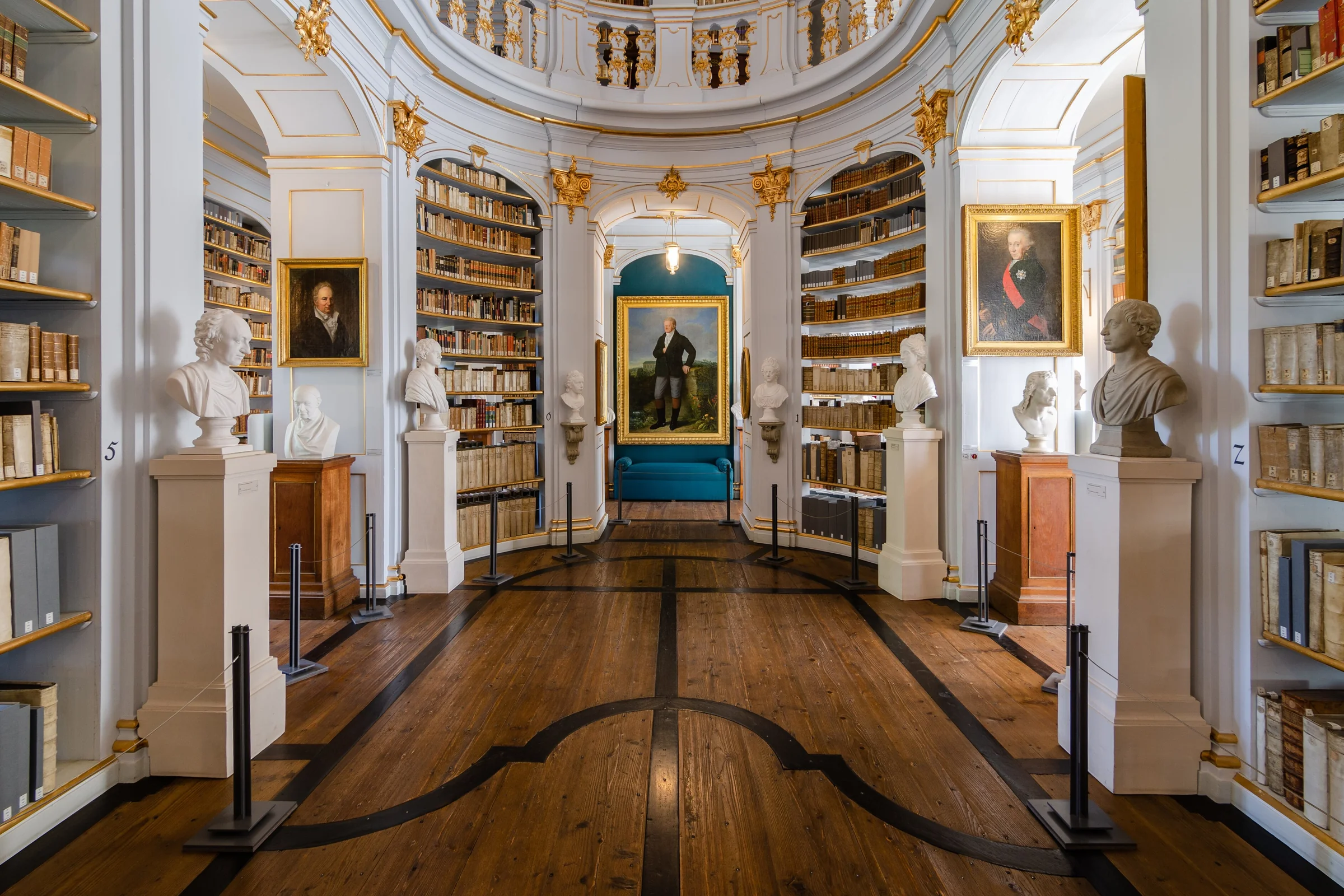
The Rococo Hall rewards the effort it takes to enter. It is an oval room of white, gold and warm wood, rising through tiered galleries that wrap the whole space in books. Around 1 million volumes belong to the wider library, and here the shelves climb the curved walls in disciplined ranks, their spines forming a texture that changes as you move. The proportions are the point: the oval draws your eye upward and around, and there is no single wall to stand in front of, so the room reads as one continuous, luminous sweep.
Overhead, an oval skylight lets daylight fall softly into the centre, catching the gilding on the balustrades and the pale plasterwork. The effect shifts hour to hour and with the weather, which is part of why the room feels alive rather than staged. Set among the books are busts and portraits of the writers and thinkers of Weimar's classical age, the poets and scholars whose work made this a working library at the heart of German culture. This was the golden-age library of the city, shaped in the eighteenth century under Duchess Anna Amalia, with Goethe himself serving as its supervisor, and it holds real treasures, including an important collection gathered around the Faust legend.
Knowing a little of that history changes what you see. The gleaming restoration is not merely decorative: much of what surrounds you was recovered or rebuilt after the 2004 fire, and the completeness of the room today is a quiet achievement in itself. Give your eyes time to travel from the floor to the galleries to the skylight, look for the individual busts rather than treating them as a blur, and notice how the curved shelving turns a library into a piece of architecture. Thirty minutes is short, so spend it looking up and around rather than trying to read titles.
How the timed entry works
Entry to the Rococo Hall runs on timed slots, and the mechanics are straightforward once you know them. Your ticket admits you for a specific window on a specific day, and the visit itself is short: you have roughly 30 minutes inside the hall. That is by design, keeping the number of people in the room low at any one moment, so the slot time on your ticket matters and is not merely a suggestion. Plan to arrive a little ahead of it so you are ready to enter promptly when your window opens.
Tickets are sold in advance, typically a few months out, and are delivered as a print-at-home or mobile PDF e-ticket, so there is nothing to collect on arrival beyond having your ticket ready to show. We offer two options. The Rococo Hall timed ticket is our single per-person rate and covers the hall itself. The combined ticket, for a small step up per person, adds the library's exhibition alongside your hall visit, which is worth considering if you want more context around what you have seen and a little longer in the building overall. Children and young people under sixteen enter free, and reduced rates apply for students and concession-holders on presentation of valid proof at entry.
For timing your day, the 30-minute hall viewing is the fixed core, but you should allow more than that overall. Add time to reach the library, to arrive before your slot, and, if you have the combined ticket, to see the exhibition at your own pace. Setting aside something in the region of an hour and a half to two hours for the whole visit is comfortable and leaves room to enjoy the surrounding square and streets afterwards rather than dashing off. Because slots are fixed and the cap is firm, missing your window is not something to risk, so build a margin into your morning.
Photography, bags and etiquette
The Rococo Hall is a conservation space first and a sight second, and the rules inside reflect that. Photography is often restricted to protect the room and its contents, and where any limits apply they are there for the sake of the books, the paintings and the fragile restored surfaces rather than to inconvenience visitors. Assume that flash is not permitted under any circumstances, since bright light is genuinely harmful to old paper and pigment, and be ready to put a camera or phone away entirely if asked. Treat the hall the way you would a gallery of irreplaceable originals, because that is exactly what it is.
Large bags, backpacks and umbrellas are the other common friction point. Historic interiors with narrow galleries and close-set shelving cannot accommodate bulky items, both to prevent accidental knocks and to keep the limited floor space clear for the small group inside. Travel light for this visit, or be prepared to leave larger items as directed before you enter. Food, drink and anything that could mark or damage surfaces stay outside.
Etiquette in the hall is mostly common sense given the setting. Keep your voice low, move calmly on the galleries, and do not touch the books, the balustrades or the busts. The room is quiet by nature, and part of its magic is that the cap keeps it that way, so a little restraint from everyone preserves the experience for the whole group. With only a short window inside, the best approach is to arrive relaxed, follow whatever guidance you are given on entry, and then simply spend your thirty minutes looking. The hall does not need to be photographed to be remembered, and many visitors find that putting the camera down and looking properly is what makes it stay with them.
Accessibility
The Rococo Hall sits inside a historic building, and it is worth understanding the layout before you arrive so the visit goes smoothly. The room is arranged over an oval floor with tiered galleries rising above it, and while the main hall floor is the heart of the experience, the upper galleries are reached by historic staircases that are not suited to every visitor. The good news is that the essential view, standing on the oval floor and looking up through the tiers of books to the skylight, is the one most people come for, and it is the most accessible part of the room.
Because the building is old and protected, step-free routes and facilities are not as extensive as in a purpose-built modern museum, and details can change with ongoing conservation. If you or anyone in your party has specific mobility, sensory or access needs, tell us when you book. We can check what provisions are in place for your date, flag any steps or constraints you should know about in advance, and make sure your slot is arranged with those needs in mind rather than leaving you to discover a barrier on the day.
A few practical notes help regardless of individual needs. The timed slot and short viewing mean the pace inside is brisk, so if you need a little more time or a steadier route, it is best to raise that ahead of the visit. Central Weimar around the library is largely walkable, with the historic square and surrounding streets close by, though some of the older paving is uneven underfoot. Planning your approach to the building, and allowing extra time to reach it comfortably, matters more here than at many sights, precisely because the entry window is fixed and cannot flex to accommodate a late or difficult arrival.
Getting there
The library stands on the Platz der Demokratie in the centre of Weimar, which makes it easy to reach on foot once you are in the city. It is a short walk from the market square and only a few minutes from the Goethe and Schiller houses, so the hall sits naturally within a day of exploring classical Weimar rather than off on its own. The whole historic core is compact and walkable, and you will pass a good deal of the city's heritage simply getting from one sight to the next.
Weimar is well connected by rail, which is the simplest way to arrive. Trains run frequently from Erfurt, roughly 15 minutes away, so Erfurt makes a convenient base or connection point if you are coming from further afield. From larger cities the journey is longer but still comfortable as a day trip: reckon on around two hours from Leipzig and a similar broad journey time from Frankfurt, with connections through the regional network. Once you step off the train, central Weimar and the library are a walk into town rather than a further transfer, though you should allow time for that walk when planning around a fixed slot.
Because your entry window is timed and the cap is strict, the golden rule is to arrive in Weimar with margin to spare. Aim to be in the city comfortably before your slot, not cutting it fine on a connecting train, so that a delayed service or a slower walk than expected does not cost you the visit. If you are combining the Rococo Hall with the Goethe and Schiller houses, the Weimar City Palace, the Park an der Ilm or the Bauhaus Museum, it is easiest to anchor the day around your fixed hall time and let the flexible sights fall before and after it. Weimar rewards a wander, so leaving time on either side of your slot is time well spent.
Frequently asked
How far in advance should I book the Rococo Hall?
As early as you comfortably can. Only a limited number of timed tickets are released each opening day, and they sell out well ahead, especially on weekends and in peak season. Popular slots can be gone months in advance, so booking early and offering a couple of flexible dates gives you the best chance of the day you want.
How long does a visit to the Rococo Hall take?
The viewing of the hall itself is short, about 30 minutes, which keeps the number of people inside low. Allow more for the whole visit, though: roughly an hour and a half to two hours once you factor in arriving before your slot, the combined exhibition if you choose it, and the walk to the library.
Can I take photos inside the hall?
Photography is often restricted inside the Rococo Hall to protect the room and its historic contents, and flash is not permitted. Where limits apply, please follow the guidance you are given on entry and be ready to put your camera away. Treat it as a gallery of irreplaceable originals, because that is what it is.
What are the opening hours?
The hall is generally open Tuesday to Sunday and closed on Mondays, typically from around 09:30 with last timed entries in the early afternoon, roughly 14:30 or a little later. Hours vary by season, so we confirm the exact windows available for your chosen date when we arrange your booking.
Do children need a ticket?
Children and young people under sixteen enter free, and reduced rates apply for students and concession-holders who show valid proof at entry. Because the hall is capped, it is still worth telling us your full party when you book so we can confirm the timed slot works for everyone travelling with you.